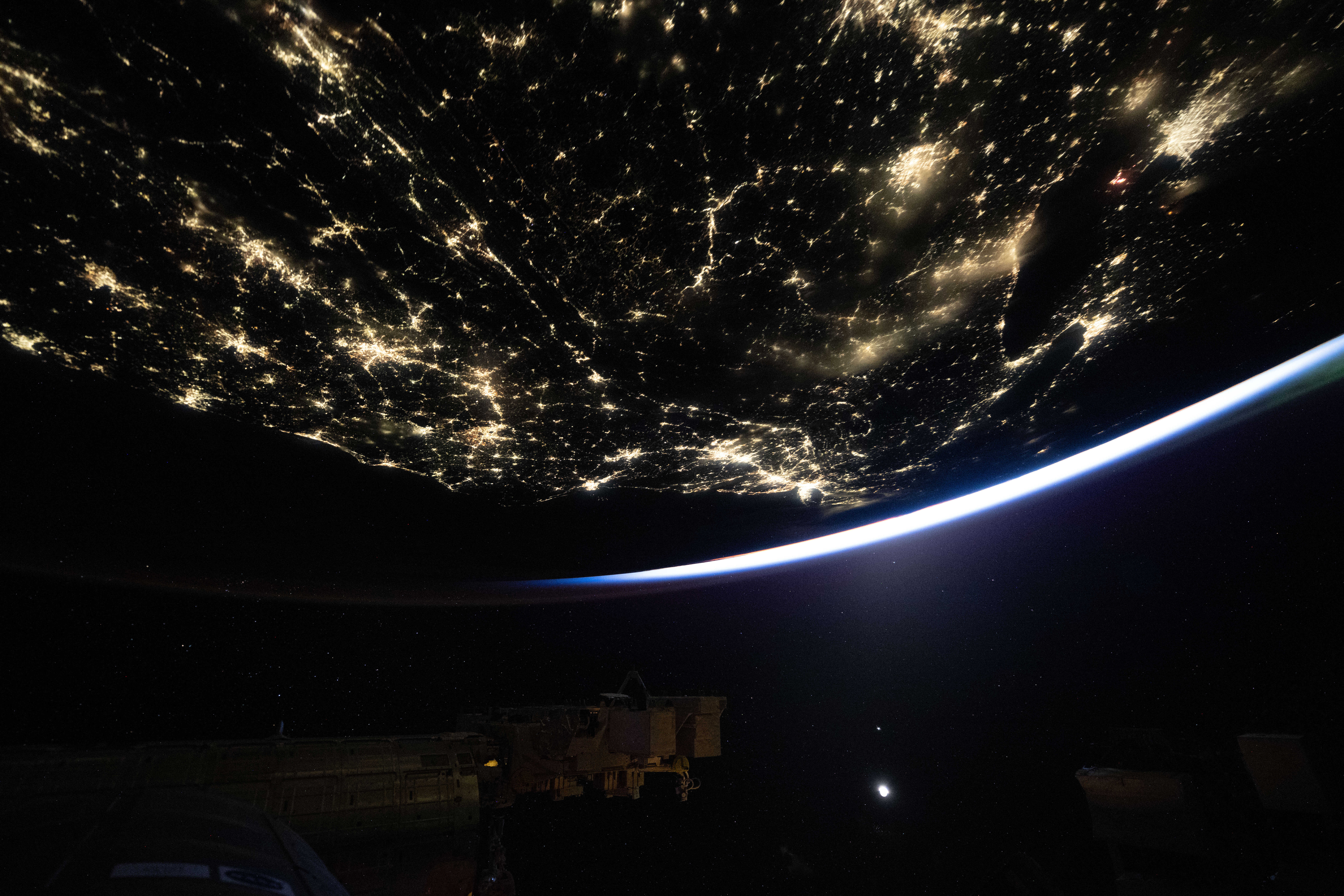
Astronaut Jessica Meir captured a striking photograph of North America's nocturnal landscape from the International Space Station on September 8, 2026, revealing the electrical infrastructure that defines modern civilization from orbital altitude. The image, taken at 3:40 a.m. local time from 259 miles above Earth, shows the northeastern United States with New York City prominent at center, surrounded by the constellation of smaller metropolitan areas and suburban networks that mark the densest population corridor on the continent.
The photograph documents what scientists term "light pollution" or "artificial night sky brightness," a phenomenon increasingly studied by researchers aboard the ISS. From its vantage point traveling at roughly 17,500 miles per hour, the space station provides an unfiltered view of how electrical lighting systems concentrate in population centers and along major transportation corridors. The ISS orbits the planet every 90 minutes, passing over every latitude between 51.6 degrees north and south, positioning it as an ideal platform for observing Earth's nocturnal patterns from multiple perspectives and seasons.
Observations like Meir's serve practical applications beyond aesthetics. NASA and international space agencies use station-based imaging to track urbanization patterns, assess energy consumption across regions, and monitor light pollution's expanding reach into previously dark areas. The data helps urban planners, environmental scientists, and policy makers understand human settlement patterns and their ecological consequences. Light pollution affects wildlife migration, disrupts circadian rhythms in both animals and humans, and wastes substantial energy resources that could be redirected to other applications.
The International Space Station remains one of humanity's most productive observation platforms for Earth science. Sixty-five cameras and numerous multispectral instruments aboard the station generate terabytes of imagery monthly, covering atmospheric conditions, ocean temperatures, ice sheet dynamics, volcanic activity, wildfire progression, and agricultural patterns. Astronauts contribute personal observations and targeted photography that complement automated sensor data, often capturing phenomena that require human judgment to identify and document effectively.
Meir, who has logged more than 1,000 hours aboard the ISS across multiple expeditions, exemplifies the dual role modern astronauts play in space station operations. Beyond conducting microgravity experiments and maintaining station systems, crew members serve as both technical operators and scientific observers, bringing specialized expertise in fields ranging from biology to geology to atmospheric physics. Her nighttime photograph of the continent, taken during a period when most observers on the ground sleep, adds to a growing archive of Earth observation imagery that documents our planet's changing relationship with artificial light.
The ISS continues its mission operating 259 miles above Earth's surface, maintained by rotating crews from NASA, Roscosmos, ESA, and JAXA. The station remains scheduled for continued operations through the 2030s, ensuring that astronauts will continue capturing and transmitting high-resolution imagery of Earth's surface, atmosphere, and human infrastructure for years to come.