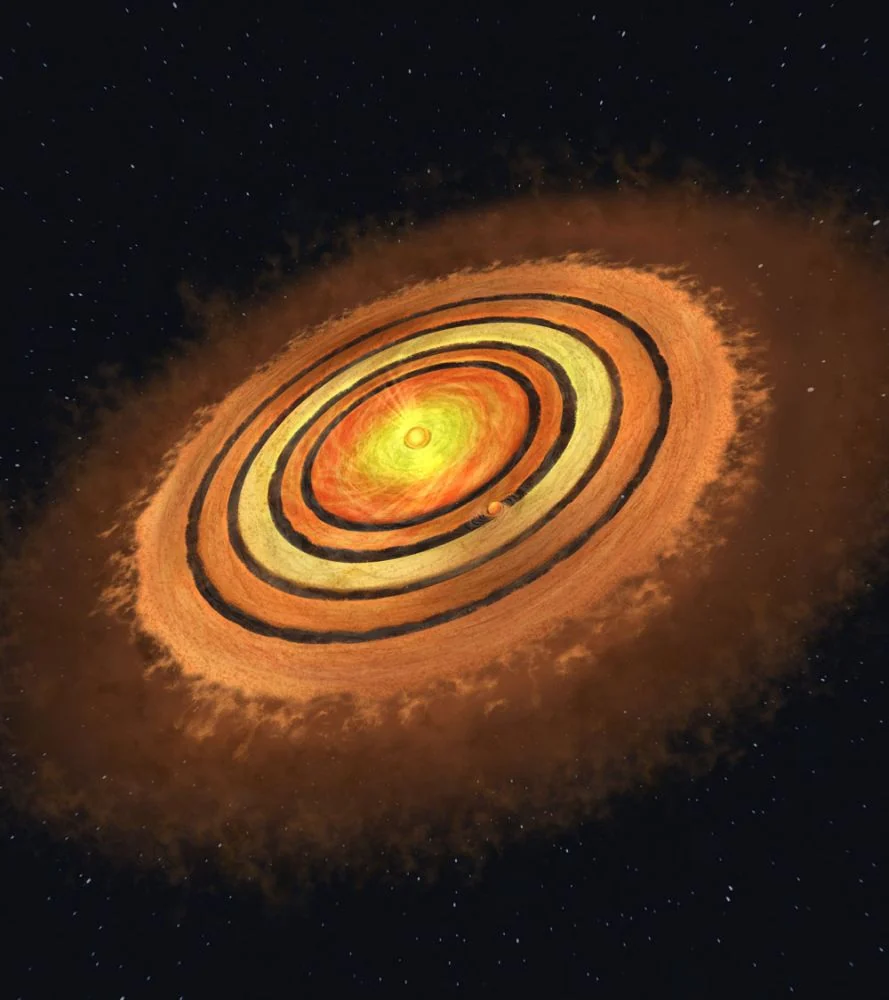
ALMA observations of the protoplanetary disk around V1094 Scorpii reveal that not all rings and gaps are carved by forming planets. The young star, located about 500 light-years away, hosts a disk extending to 300 astronomical units with multiple ring-gap pairs at exceptional distances from the star.
Researchers led by Masayuki Yamaguchi of Kyushu University used ALMA data processed through a new super-resolution technique called PRIISM to analyze the disk's structure. They found four narrow dust rings and gaps between 100 and 230 AU from the star's center. When they tested whether a single planet could explain each gap, the pattern did not fit.
The innermost gap at roughly 100 AU appears consistent with a low-mass planet of about 55 Earth masses. But the outer rings showed regular spacing incompatible with planet formation. Instead, these outer rings match the predictions of secular gravitational instability, where dust clumps together under its own gravity without requiring planets.
"The ensemble of gap widths and depths is inconsistent with a simple one-planet-per-gap interpretation," the authors write in The Astrophysical Journal. Secular gravitational instability intrinsically produces evenly spaced rings, while exoplanets do not.
Yamaguchi noted that ALMA, as a radio telescope, cannot directly detect planets. Other instruments like the Subaru Telescope may help reveal whether planets exist in V1094 Sco's disk. The findings suggest a hybrid pathway where dust concentrations form through gravity while planets also shape disk structures at intermediate radii.