# NASA Tests Advanced Landing System for Lunar Missions
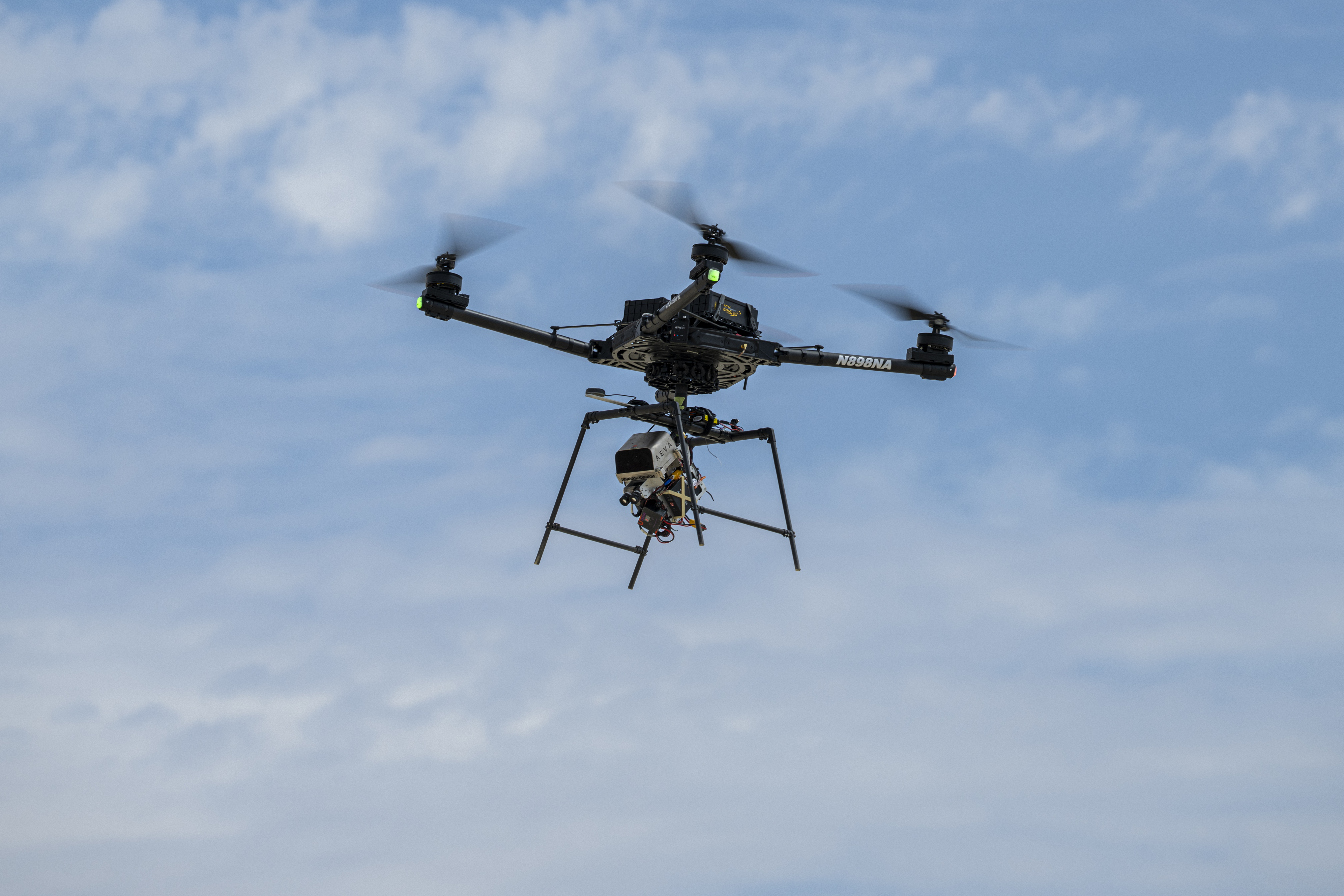
NASA researchers are developing and testing a sophisticated guidance system designed to help spacecraft land safely and accurately on the Moon and beyond. The agency's Johnson Space Center in Houston created SPLICE, the Safe and Precise Landing – Integrated Capabilities Evolution experiment, which completed simulated lunar descent trials using an Alta-X drone near NASA's Armstrong Flight Research Center in Edwards, California.
The SPLICE system addresses one of the most demanding challenges in lunar exploration: autonomous precision landing. During Apollo missions, astronauts manually piloted their lunar modules during final descent phases. Modern crewed and robotic missions require spacecraft to land with minimal human intervention, particularly in scientifically interesting locations where terrain hazards pose significant risks.
SPLICE integrates multiple technologies into a unified navigation architecture. The system combines real-time terrain mapping, hazard detection, and autonomous guidance to steer spacecraft toward safe landing zones while avoiding rocks, boulders, and crater walls. Traditional inertial navigation systems accumulate errors over time. SPLICE supplements these with optical sensors and advanced algorithms that process landing site imagery during descent, continuously updating trajectory calculations.
The August 2026 test flight demonstrated the system's capability to execute a simulated lunar descent profile. Researchers flew the Alta-X drone, a medium-altitude, long-endurance unmanned aircraft, to replicate the flight dynamics and sensor operations that spacecraft would experience during actual lunar approaches. Testing in Earth's atmosphere allows engineers to gather performance data before committing hardware to lunar missions, where system failures cannot be repaired or recovered.
This development supports multiple NASA initiatives. The Artemis program aims to land astronauts on the lunar south pole region by 2026. That region contains permanently shadowed craters with water ice deposits, scientifically valuable but demanding from a navigation standpoint. Artemis lunar landers must touch down with high precision in challenging terrain while managing fuel constraints and sensor limitations.
Beyond lunar applications, SPLICE technology enables deeper space exploration. Future Mars missions will require similar autonomous landing capabilities. The Martian atmosphere complicates entry, descent, and landing operations. Spacecraft cannot rely on real-time human guidance from Earth because radio signals require up to 20 minutes each way to travel between planets. Rovers and landers must make autonomous navigation decisions during their final approach phases.
The Johnson Space Center's investment in SPLICE reflects NASA's commitment to landing infrastructure as foundational exploration capability. Reliable, accurate landing systems make the difference between mission success and failure. They enable spacecraft to reach scientifically compelling locations. They support human spaceflight by providing reliable touchdown precision for crew safety.
NASA plans to integrate SPLICE technology into upcoming lunar missions and continue refinement through additional flight tests. The system may also support commercial lunar lander programs through NASA's Commercial Lunar Payload Services initiative, where private companies transport scientific instruments to the Moon for the agency.
Autonomous precision landing represents the threshold between arriving at distant worlds and exploring them effectively. SPLICE moves that threshold forward.