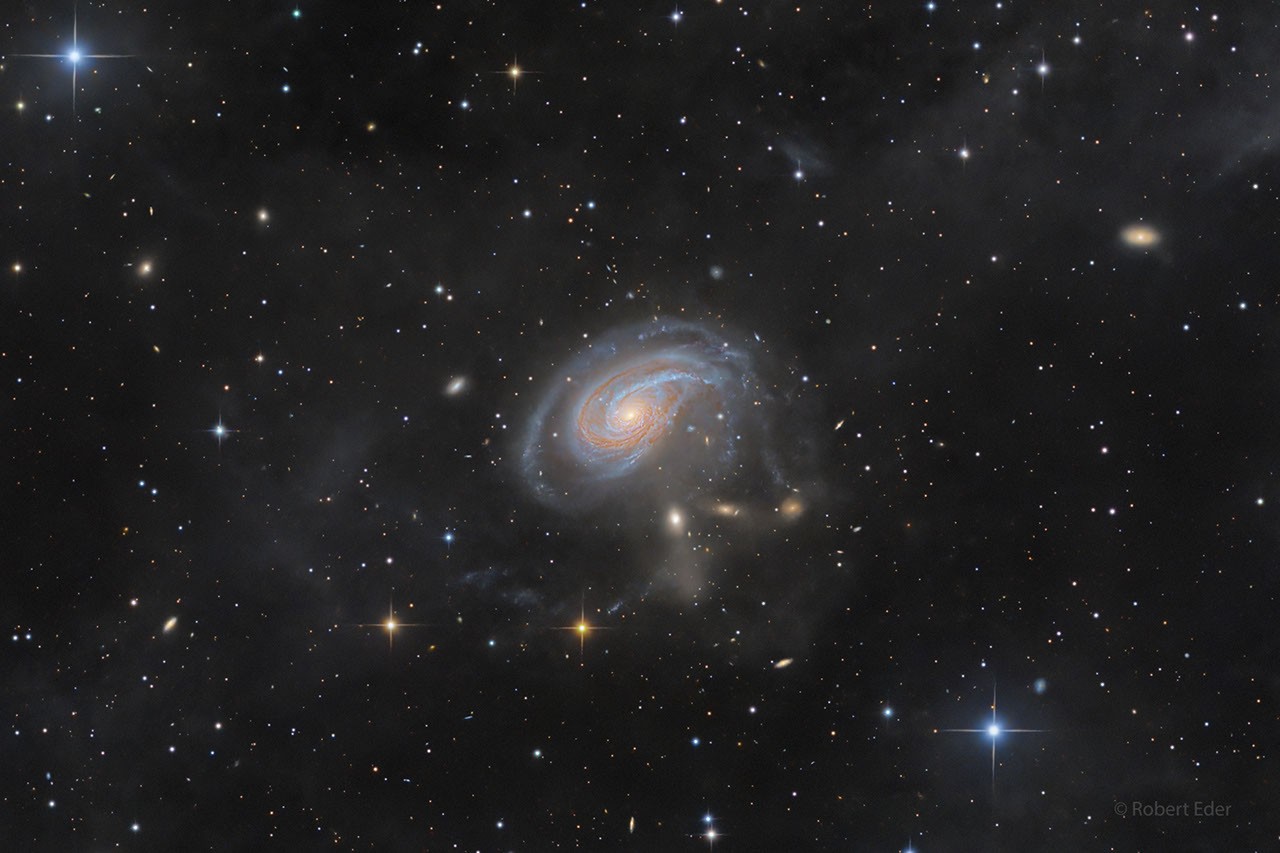
# Arp 78 Reveals the Violent Dance of Colliding Galaxies
Arp 78, a peculiar galaxy located in the constellation Aries, stands as a cosmic wreckage site where two galaxies collided billions of years ago. This object appears in Halton Arp's Atlas of Peculiar Galaxies, a 1966 catalog that documented gravitational interactions between galaxies and their visible deformations across the electromagnetic spectrum.
The galaxy's distorted morphology tells a story of gravitational violence. When two galaxies collide, they do not simply bounce apart like billiard balls. Instead, their mutual gravitational pulls reshape their structures over millions of years, pulling long tidal tails of stars and gas across space. Arp 78 displays this transformation in its asymmetric form, with material stretched and redistributed by the immense gravitational forces at work.
Ground-based and space-based telescopes, including NASA's capabilities, have captured detailed imagery of Arp 78. These observations reveal not just the overall distorted shape but also regions of active star formation triggered by the collision. When galactic material compresses during merger events, gas clouds collapse and ignite massive star birth. Arp 78 shows evidence of this process in regions where young, hot stars energize surrounding hydrogen gas, producing distinctive emission signatures.
The study of Arp 78 and similar systems provides crucial data about galaxy evolution across cosmic time. Contemporary universe surveys reveal that galaxy mergers were far more common in the early universe than they are today. By studying objects like Arp 78, astronomers decode how galaxies grow, how they acquire their mass, and how supermassive black holes at their centers influence the merger process. These interactions fundamentally shape galaxy morphology: spiral galaxies can transform into elliptical galaxies through major mergers, altering their rotation, structure, and star formation rates.
Arp 78 resides approximately 100 million light-years away, placing it near enough for detailed observation yet far enough to represent processes occurring across billions of years of cosmic history. The galaxy exemplifies how gravitational dynamics operate at the largest scales, where objects separated by thousands of light-years can still exert powerful mutual influence.
Modern astronomical surveys continue expanding the catalog of merging and peculiar galaxies. The James Webb Space Telescope, with its infrared sensitivity, penetrates dust-obscured regions where star formation intensifies during collisions, revealing merger dynamics invisible to visible-light telescopes. These observations refine models of galaxy formation and test predictions about how matter accumulates into the largest structures in the universe.
Arp 78 reminds observers that the universe remains dynamic and violent, even at the grandest scales. What appears static in any single observation actually represents galaxies in the midst of cosmic-scale transformations. Understanding these processes directly informs how we interpret the distant universe and reconstruct the assembly history of galaxies like our own Milky Way, which itself experienced multiple mergers during its 13.8-billion-year history.