# Harvest Moon Frames Sicily's Most Active Volcano in Rare Celestial Convergence
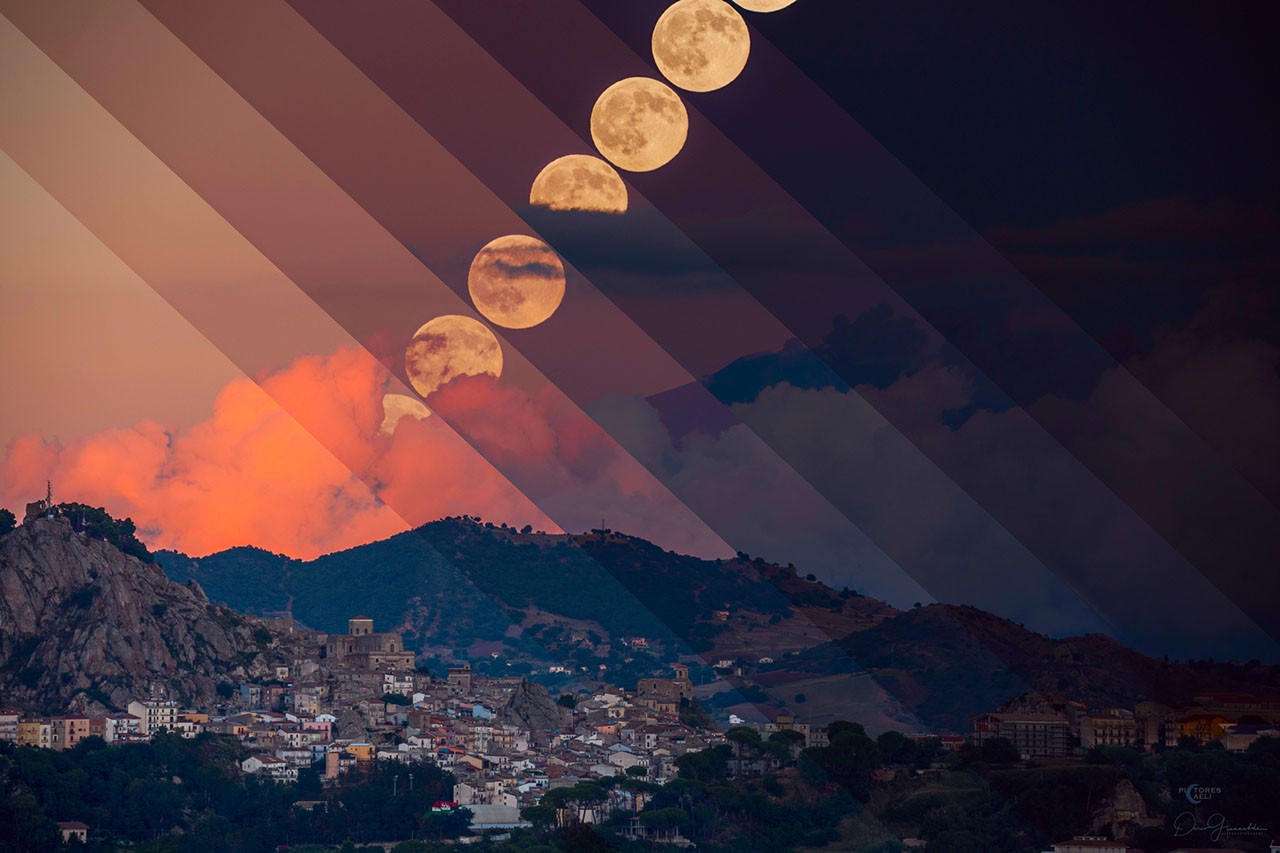
NASA's Astronomy Picture of the Day captured a dramatic convergence of lunar and terrestrial geology on October 1, 2026: the Harvest Moon illuminating Mount Etna during an eruption on Sicily's eastern coast.
The Harvest Moon, the full moon occurring nearest the autumnal equinox in the Northern Hemisphere, carries historical and practical significance. Before electric lighting, farmers depended on its bright illumination to extend harvest work into evening hours. The name persists today as a marker of seasonal transition, though the celestial mechanics remain unchanged: the moon reaches full phase when Earth positions itself directly between the sun and moon, casting sunlight fully across the lunar surface visible from Earth.
Mount Etna represents Europe's most active volcano. Located on the eastern shore of Sicily, the 3,329-meter peak sits atop the boundary where the African tectonic plate subducts beneath the Eurasian plate. This collision zone has sustained Etna's volcanic activity for at least 700,000 years, with documented eruptions spanning back to at least 1500 BCE.
The convergence captured in this APOD image created a rare photographic opportunity. The Harvest Moon's brightness cast sharp shadows across Etna's slopes and illuminated volcanic emissions rising from the summit craters. Ground-based photographers positioned themselves to frame both the moon and volcano within a single field of view, requiring precise timing, location, and atmospheric conditions. Dust and aerosols ejected by the volcano's eruption column scattered and colored the lower light, creating visual contrast between the moon's steady luminescence and the dynamic volcanic outgassing.
This type of image serves multiple purposes in astronomy and Earth science education. For astronomers, it demonstrates the moon's role as a natural light source that shapes visibility of terrestrial phenomena. For volcanologists, it documents Etna's ongoing activity and provides visual evidence of eruption intensity. For educators, it illustrates the intersection of lunar cycles, seasonal astronomy, and active geology within a single frame.
Etna erupts continuously, with periods of intense activity and relative quiescence following irregular patterns. The volcano's persistent degassing and episodic lava fountaining stem from the complex plumbing of magma chambers and conduits beneath the surface. Each eruption releases dissolved gases, primarily water vapor, carbon dioxide, and sulfur dioxide, which escape as visible plumes visible from kilometers away.
Photography combining celestial and terrestrial subjects requires understanding both sky mechanics and ground-based positioning. The photographer must calculate moon phase, time of moonrise and moonset, and position relative to Etna. Atmospheric transparency, weather patterns, and light pollution all determine whether such an image becomes possible.
The October 2026 capture documents a specific moment in Etna's activity cycle alongside a predictable lunar phase. The image underscores how Earth's moon and dynamic planetary geology offer constant opportunities for visual discovery. Routine astronomical phenomena paired with active volcanism create teaching moments about both celestial mechanics and planetary processes.