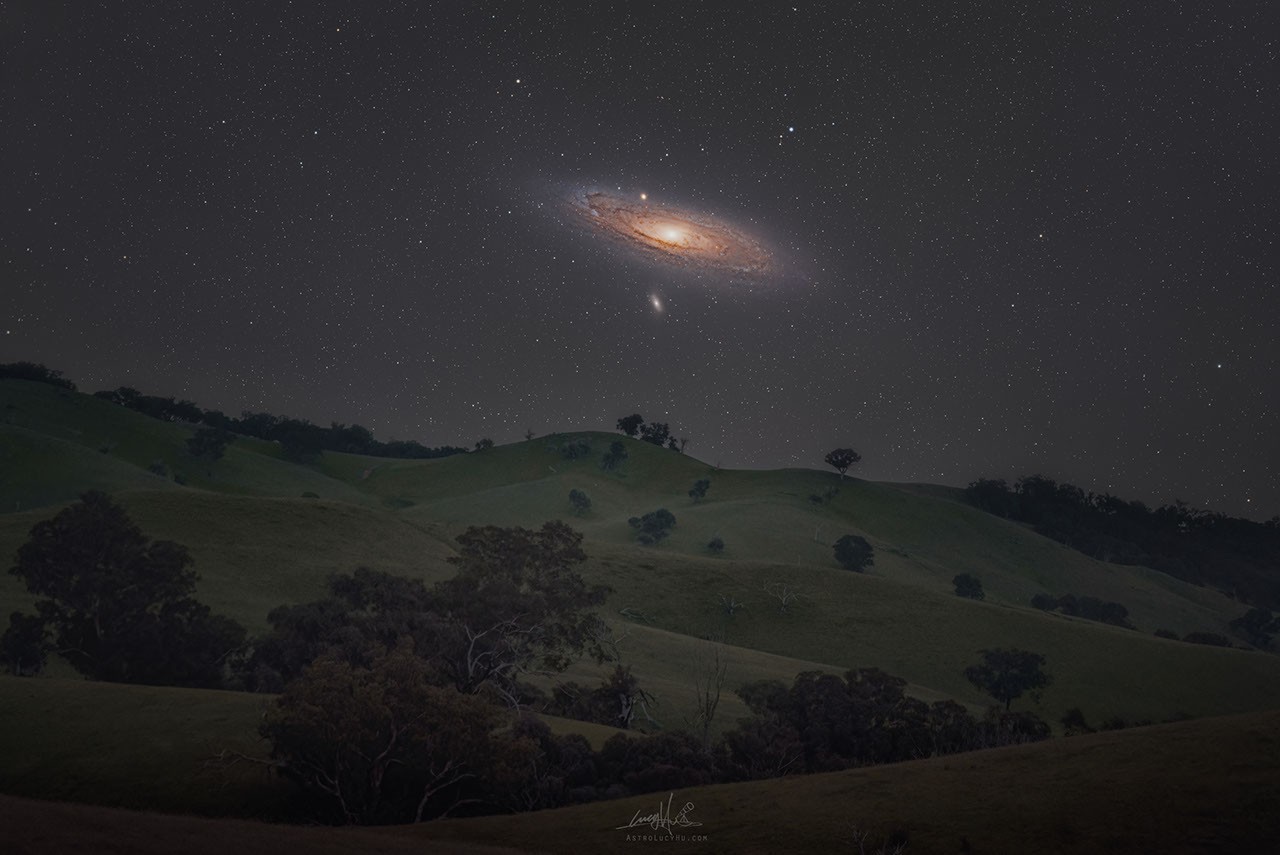
The Astronomy Picture of the Day (APOD) for October 23, 2026 captures Andromeda galaxy as observed from Mullion, New South Wales, Australia during the Southern Hemisphere's spring season. This daily NASA feature, published since 1995, continues its tradition of presenting astronomical observations alongside professional scientific commentary.
Andromeda galaxy, formally designated Messier 31 or M31, represents the largest spiral galaxy in the local group and sits approximately 2.5 million light-years from Earth. The galaxy contains roughly one trillion stars, dwarfing our own Milky Way in stellar population, though current evidence suggests the Milky Way may possess greater total mass. Andromeda remains the most distant object visible to the naked human eye under dark sky conditions, making it an enduring target for both amateur and professional astronomers worldwide.
The perspective from Mullion, located on Australia's south coast in New South Wales, offers a distinct viewing angle. Southern Hemisphere observers see Andromeda positioned differently in their night sky compared to Northern Hemisphere viewers, with the galaxy's orientation appearing rotated. This geographic vantage point demonstrates how celestial coordinates shift based on observer location, a principle fundamental to positional astronomy and navigation.
During Australian spring, which runs from September through November, seasonal atmospheric conditions and daylight patterns create specific observational windows. The longer southern spring nights and shifting constellations provide opportunities for extended observation periods. Andromeda's visibility from the Southern Hemisphere occurs when the galaxy rises above the northern horizon, requiring observers to look toward the north from locations like Mullion.
APOD has operated continuously since June 16, 1995, delivering daily astronomical images to a global audience. Each entry combines high-quality astronomical photography or illustration with explanatory text authored by professional astronomers and astrophysicists. The program serves educational purposes across multiple levels, from casual observers seeking naked-eye object information to researchers examining specialized astronomical phenomena.
The specific focus on Andromeda from a Southern Hemisphere location highlights the galaxy's universal accessibility across Earth's latitudes. Andromeda serves as a laboratory for stellar population studies, dust distribution analysis, and gravitational dynamics. Astronomers continue investigating Andromeda's structure, star formation rates, and its eventual collision with the Milky Way, predicted to occur in approximately 4.5 billion years.
Modern observations of Andromeda employ multiple wavelengths beyond visible light. Space telescopes including the Hubble Space Telescope and more recently the James Webb Space Telescope provide infrared data revealing hidden star-forming regions and stellar populations obscured by dust. Ground-based surveys continue mapping Andromeda's structure and cataloging its billions of constituent objects.
The APOD entry emphasizes how astronomical observation transcends geographic boundaries. Whether viewed from Australia or elsewhere, Andromeda remains a cornerstone object for understanding galaxy structure, stellar populations, and the cosmos's large-scale organization. Each daily APOD entry reinforces this accessible wonder while advancing public understanding of observational astronomy and the universe's scale.