# Dark Matter Visualization Offers New Window Into Universe's Hidden Architecture
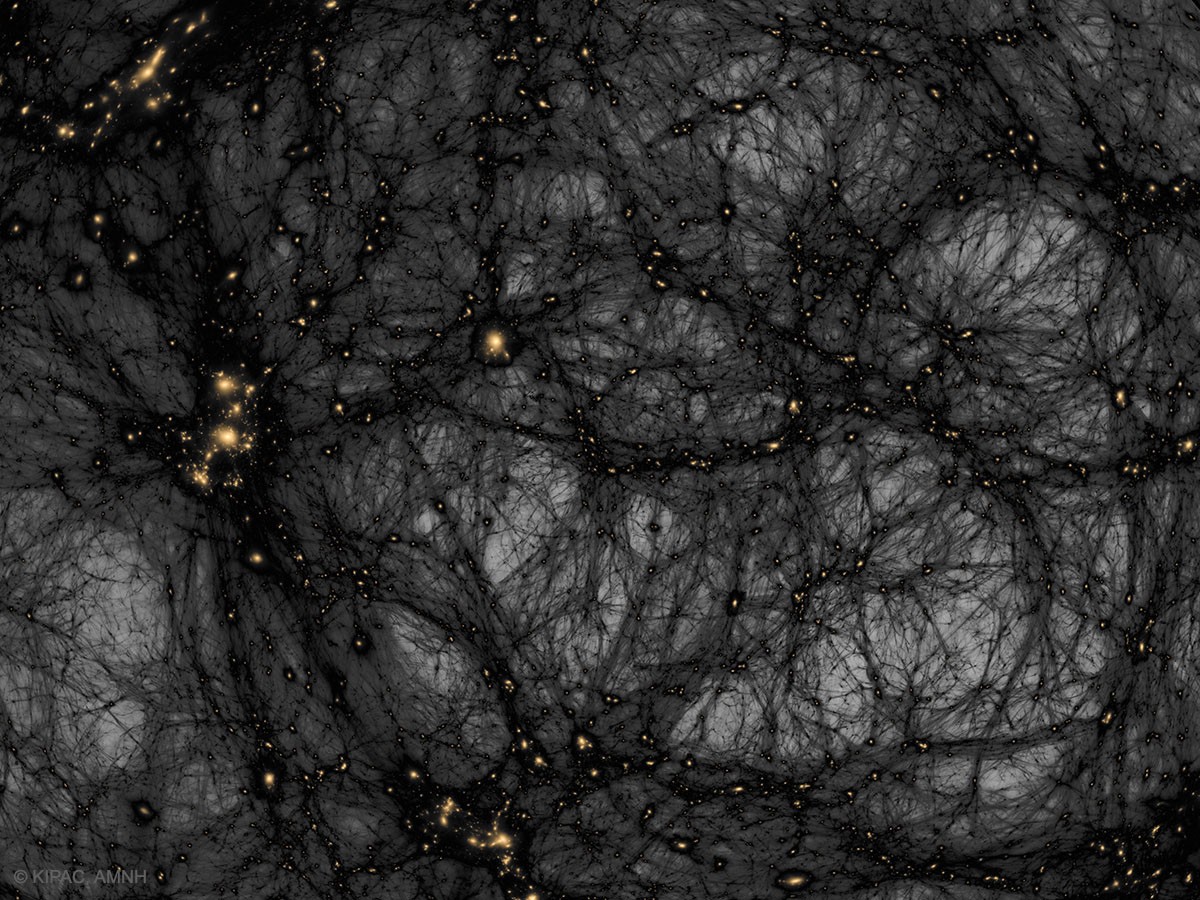
NASA's Astronomy Picture of the Day series has featured a simulated visualization of dark matter distribution across a vast cosmic region, providing astronomers with a computational model of how the universe's invisible scaffolding shapes visible structures.
Dark matter comprises roughly 85 percent of all matter in the universe, yet remains directly unobservable. Astronomers detect its presence only through gravitational effects on visible matter, radiation, and the overall expansion dynamics of space itself. Modern cosmological simulations generate synthetic universes governed by the same physical laws that shape our own cosmos, allowing researchers to understand how dark matter filaments and halos dictate where galaxies form and cluster.
These computational universes emerge from supercomputer calculations processing billions of particle interactions. Scientists initialize simulations with conditions matching the early universe as observed through the cosmic microwave background radiation, then let gravitational physics evolve the system forward through billions of years of simulated time. The result reveals dark matter's lumpy distribution, concentrated in dense nodes connected by thin filamentary threads that form what cosmologists call the cosmic web.
The visualization shown in this APOD image renders dark matter density directly. Brighter regions indicate higher concentrations. Galaxies form preferentially along these filaments and at their junctions, which explains the observed large-scale structure of the universe. Galaxy surveys like those conducted by the Sloan Digital Sky Survey map billions of galaxies and find precisely this filamentary pattern predicted by dark matter simulations decades earlier.
Understanding dark matter distribution matters for multiple research areas. Gravitational lensing studies use foreground galaxy clusters to magnify distant objects, but accurately modeling these lensing effects requires knowledge of dark matter's three-dimensional mass distribution. Simulations provide that framework. Researchers also use dark matter models to interpret observations from the James Webb Space Telescope and other observatories seeking to understand how the first galaxies assembled in the early universe.
Several major simulation projects now produce publicly available datasets. The Illustris simulation, completed at MIT, tracked 20 billion particles across a box spanning 100 million light-years. The Eagle simulation, run at the University of Durham, produced comparable volumes with different physics implementations. The Flamingo simulations, completed more recently, incorporated baryonic physics representing ordinary matter with unprecedented accuracy, allowing direct comparison between simulated and observed galaxy populations.
These simulations also test dark matter candidates. Cold dark matter, the leading theory, produces the observed clustering patterns. Warm dark matter alternatives would produce different structures, particularly at smaller scales. Comparing simulated predictions to actual observational data from multiple surveys constrains which models align with reality.
The APOD archive entry reflects NASA's ongoing commitment to public science education, presenting complex computational astrophysics in visually accessible form. Each image publication includes technical explanations written by professional astronomers, serving millions of annual visitors seeking to understand the universe's fundamental nature.