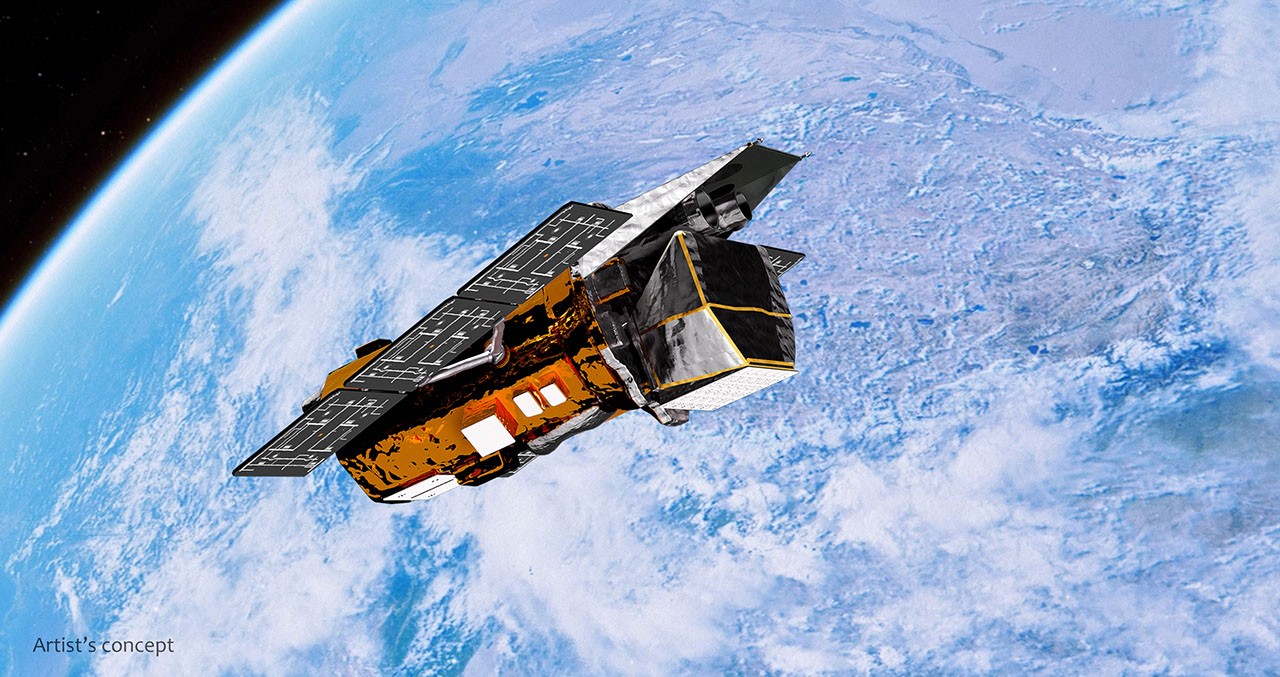
NASA's Neil Gehrels Swift Observatory concluded its groundbreaking science operations in October after nearly two decades of transformative observations. The spacecraft, which has orbited Earth since its 2004 launch, exhausted its ability to conduct astronomy when atmospheric drag pushed it below 171 miles of altitude, where the density of residual air prevents the satellite's instruments from maintaining stable focus on distant objects.
Swift's final observation occurred on October 20, marking the end of a mission that fundamentally altered our understanding of the universe's most violent phenomena. The observatory specialized in detecting gamma-ray bursts, the most energetic explosions known to science, which occur when massive stars collapse into black holes or when neutron stars collide. Swift's rapid response system allowed it to pivot toward these transient events within seconds, enabling follow-up observations from ground-based telescopes that would have otherwise missed these fleeting cosmic events entirely.
The spacecraft's scientific legacy proves extraordinary. Swift discovered over 10,000 gamma-ray bursts during its operational lifetime, compared to roughly 700 known to exist before its launch. This dramatic increase in detections transformed gamma-ray burst astronomy from a niche field into a mainstream observational science. Each burst observed provided data that reshaped theories about stellar death, the early universe, and the formation of black holes and neutron stars.
Named after Neil Gehrels, the mission's principal investigator who died in 2017, the observatory carried three primary instruments: the Burst Alert Telescope, X-ray Telescope, and Ultraviolet/Optical Telescope. This multi-wavelength approach allowed scientists to observe the same cosmic events across electromagnetic spectra, revealing physics that single-wavelength observatories could never capture. When Swift detected a burst, autonomous systems could reorient the satellite and send coordinates to astronomers worldwide in under a minute, triggering a global observational response.
The mission also provided unexpected bonuses. Swift observations contributed to gravitational wave astronomy, supplying crucial data when ground-based detectors identified neutron star mergers. The spacecraft observed supernovae, active galactic nuclei, and X-ray binary systems. It tracked solar flares and contributed to solar physics research despite specialization in distant cosmic sources.
Swift's longevity exceeded expectations. Originally designed for a five-year mission, the spacecraft operated successfully for nearly 21 years, a testament to robust engineering and conservative fuel management. As orbital decay accelerated in recent months, mission controllers made the decision to conclude science operations rather than risk instrument damage or lose the ability to command the spacecraft safely.
The observatory's data archive contains terabytes of observations freely available to the global astronomy community. Researchers will continue analyzing Swift data for years, extracting physics that remains hidden in archival observations. The mission established new standards for time-domain astronomy and rapid-response science that influenced the design of successor missions including TESS and upcoming observatories.
While Swift's telescopes fall silent, its impact endures. The mission demonstrated that agile space observatories with rapid-response capabilities unlock discoveries impossible with conventional astronomical approaches. Swift's successor, the Transient High-Energy Sky and Early Universe Surveyor (THESIS), represents the next generation of burst astronomy, building directly on techniques Swift pioneered.