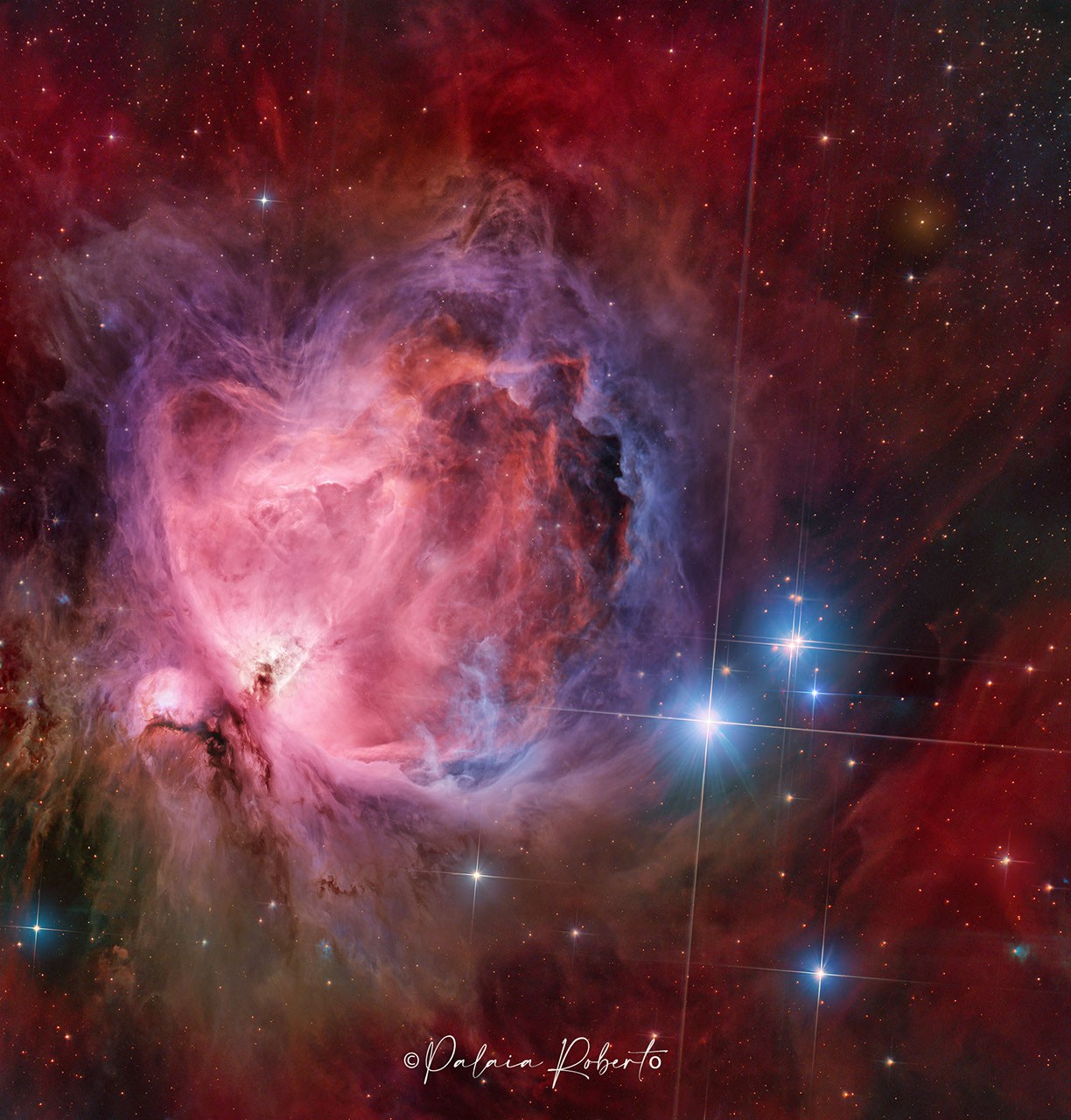
# The Great Nebula in Orion Remains One of the Universe's Most Luminous Stellar Nurseries
Messier 42 (M42), the Great Nebula in Orion, stands as one of the nearest star-forming regions to Earth and continues to captivate astronomers and the public alike. Located roughly 1,350 light-years away in the Orion constellation, this emission nebula represents a dynamic laboratory where gravity collapses vast clouds of gas and dust into newborn stars.
M42 occupies a central place in observational astronomy history. Charles Messier catalogued it in 1769 as the 42nd object in his famous list, a compilation that helped distinguish nebulae from comets during the era of telescopic discovery. Today, professional and amateur astronomers alike train their instruments on M42 to study the mechanics of stellar birth.
The nebula spans approximately 24 light-years across its observable region. Its distinctive reddish-pink coloration results from hydrogen-alpha emission, the characteristic light produced when ultraviolet radiation from massive young stars ionizes surrounding hydrogen gas. At its heart lies the Trapezium Cluster, a tight grouping of massive young stars whose fierce radiation and stellar winds carve the nebula into its serpentine structure.
Recent observations from space-based observatories including the Hubble Space Telescope and ground-based instruments have revealed the intricate architecture within M42. Astronomers detect dozens of protoplanetary disks around individual young stars, regions where planetary systems form from the leftover material of star creation. These discoveries illuminate the mechanisms by which planets coalesce from dust and gas.
The nebula's accessibility from Earth's Northern Hemisphere makes it an ideal target for educational outreach. During autumn and winter months, M42 rises high enough in the evening sky for backyard telescopes to resolve its structure. Schools and planetariums use M42 as a gateway to teach the public about stellar evolution, stellar nurseries, and the processes that govern cosmic structure formation.
Radio and infrared observations penetrate the visible nebula to reveal hidden protostars embedded within dense molecular clouds. These observations show that star formation in M42 continues actively, with new stars emerging from collapsing regions of the nebula even today. The Spitzer Space Telescope and the Atacama Large Millimeter Array (ALMA) have mapped carbon monoxide and dust emissions to trace the ongoing collapse and accretion processes.
M42 serves broader astrophysical purposes beyond local observation. Its proximity and clarity allow astronomers to test theories about star formation that apply across the universe. The physical processes occurring in M42 occur identically in distant galaxies billions of light-years away, yet the clarity of observation near Earth permits detailed study impossible in distant regions.
The Great Nebula in Orion reminds us that star and planet formation occurs not as ancient history but as an active, ongoing process. Every photon from M42 carries information about stellar nurseries and the physical forces that shaped our own solar system 4.6 billion years ago. NASA's continued study of M42 through its Astronomy Picture of the Day archive and other educational programs keeps this nebula at the center of public engagement with observational astronomy.