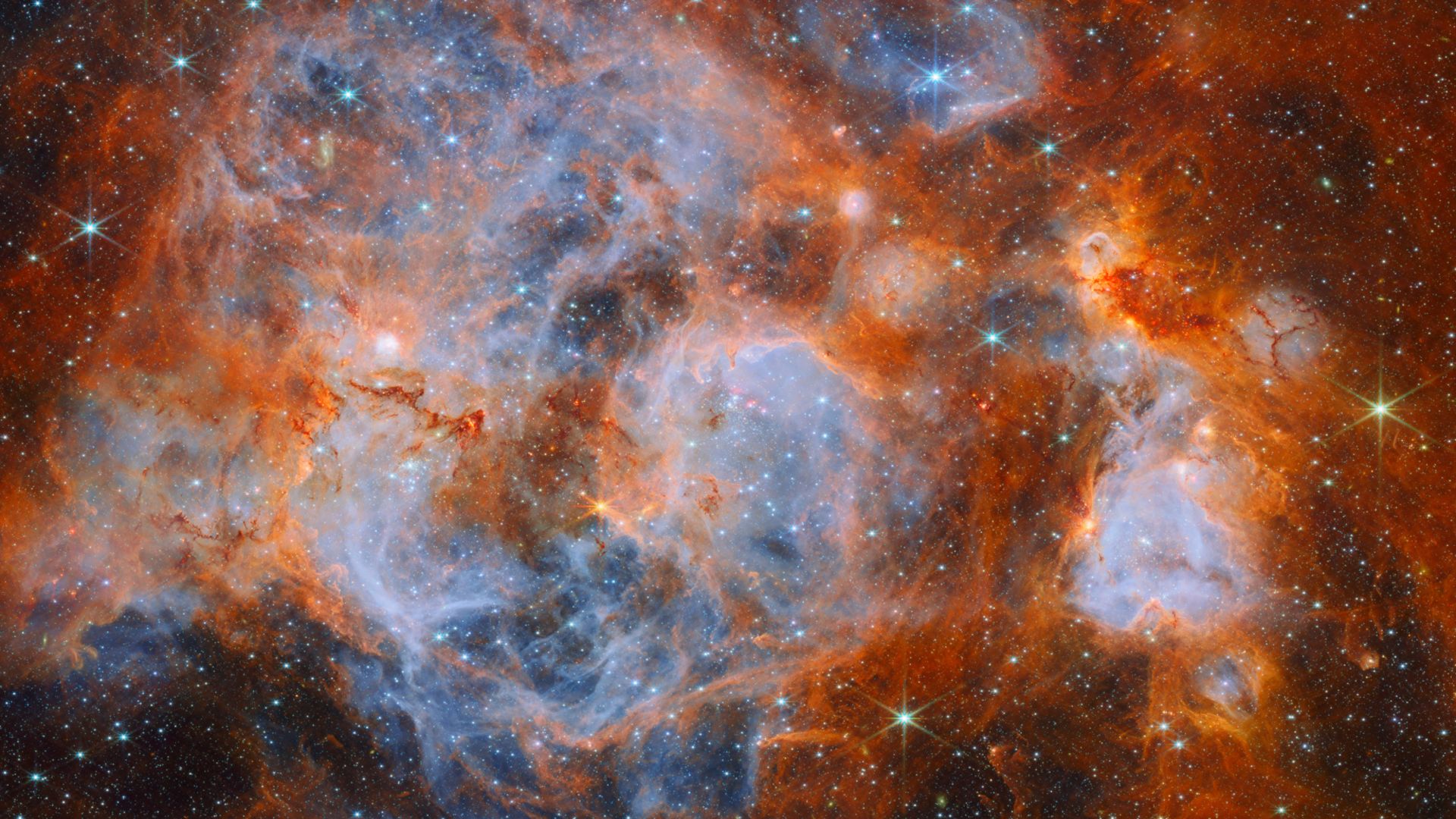
The James Webb Space Telescope has imaged a luminous star-forming cauldron 161,000 light-years distant, nestled within one of the Milky Way's satellite galaxies. This observation reveals the raw machinery of stellar birth in unprecedented detail, offering astronomers a window into how massive stars ignite and shape their surroundings across the cosmos.
The region lies in the Large Magellanic Cloud, a dwarf galaxy locked in orbit around our own. At 161,000 light-years away, this stellar nursery remains close enough for Webb's infrared instruments to resolve individual stars and the glowing gas that surrounds them. The "cauldron" designation reflects the violent, energetic environment where gravity collapses clouds of hydrogen and helium into newborn suns.
Webb's infrared sensitivity penetrates dust that visible-light telescopes cannot pierce. This capability proves essential for studying star formation, since newborn stars remain shrouded in the very dust clouds from which they condense. The observatory's Near Infrared Camera and Mid-Infrared Instrument detect the heat signatures of both emerging protostars and the energetic radiation from already-formed massive stars nearby.
The Large Magellanic Cloud serves as a laboratory for understanding stellar populations different from those in the Milky Way's disk. Its lower metallicity—fewer heavy elements forged in earlier stellar generations—creates conditions that differ fundamentally from star birth in our own galaxy. Observations of LMC star-forming regions therefore illuminate how stellar evolution proceeds across a range of chemical compositions, ultimately shaping how galaxies evolve over cosmic time.
Such images drive forward research on massive star formation, a process still not fully understood. Massive stars form from larger clouds of gas and experience powerful radiation pressure that should, theoretically, blow away their parent material before stellar accretion completes. Yet massive stars plainly exist, suggesting additional physics controls their growth. Webb observations of regions like this one map out the detailed structure of collapsing clouds and reveal how feedback from stellar radiation and winds interacts with infalling material.
The scientific payoff extends beyond stellar physics alone. Star-forming regions sculpt the galactic environments around them. Intense ultraviolet radiation from young, massive stars ionizes surrounding hydrogen gas into luminous nebulae. Stellar winds and eventual supernova explosions inject energy and heavy elements back into the interstellar medium, seeding future generations of stars and planets. Understanding these processes in the LMC, where distances and stellar densities remain manageable for analysis, accelerates the decoding of star formation physics applicable across the universe.
Webb's observations of the Large Magellanic Cloud represent the observatory's continued expansion of capabilities for resolving fine structure in distant galaxies. Launched in December 2021 and operational since July 2022, the observatory has systematically turned its 6.5-meter primary mirror toward progressively more detailed studies of star-forming regions across the local universe. These images feed directly into models of how galaxies assemble their stellar populations and how cosmic structure evolves from the universe's earliest epochs to the present day.