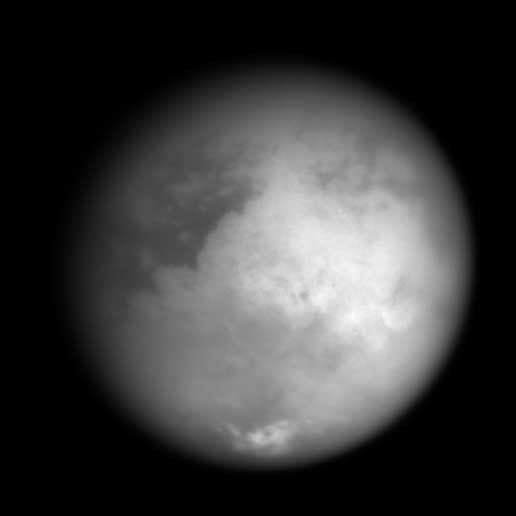
NASA's Cassini spacecraft executed a historic flyby of Saturn's moon Titan on October 26, 2004, capturing the first close-up photographs of the solar system's second-largest moon. This encounter marked a pivotal moment in planetary science, delivering the first detailed views of a world shrouded in thick organic haze that had remained largely mysterious since its discovery by Christiaan Huygens in 1655.
Titan had captivated astronomers for centuries, but the Cassini-Huygens mission, a joint effort between NASA, the European Space Agency, and the Italian Space Agency, finally pierced the veil. The spacecraft's imaging science subsystem revealed a complex, geologically diverse landscape hidden beneath a nitrogen-rich atmosphere laced with methane and other organic compounds. Those first close-up images showed vast dune fields, possible cryovolcanoes, and impact craters, suggesting an active world fundamentally different from other moons in the outer solar system.
The scientific payload aboard Cassini included multiple cameras and spectrometers. The Imaging Science Subsystem captured visible-light and infrared photographs that penetrated Titan's orange haze far better than Earth-based telescopes ever could. Infrared instruments proved particularly valuable, revealing surface features obscured at visible wavelengths. The data arrived at Earth after a signal travel time of over 80 minutes, a reminder of the vast distances involved in deep space exploration.
This October 2004 encounter represented just one leg of Cassini's four-year mission around Saturn. The spacecraft had launched from Earth in October 1997, spent seven years traversing the inner solar system, and arrived at Saturn in July 2004. The Titan flyby triggered a sequence of events that would dominate the mission's next phase. NASA and ESA had designed a probe, Huygens, to separate from Cassini and descend through Titan's atmosphere in January 2005, eventually becoming the first spacecraft to land on a moon in the outer solar system.
The October 2004 images themselves revealed topographic features that informed Huygens entry strategy and landing site selection. Scientists studied wind patterns, atmospheric opacity, and surface texture from these early photographs to optimize the probe's trajectory. The Cassini orbiter would then continue observing Titan and Saturn's other moons and rings over a nominal four-year mission that eventually extended far beyond initial projections.
Titan proved even more complex than pre-encounter models suggested. The images hinted at hydrocarbon seas near the poles, a detail confirmed later by radar data. Impact basins, linear features, and ridges suggested a tectonically active body shaped by both cryovolcanism and impact bombardment. The thick atmosphere, composed primarily of nitrogen with methane and trace organics, created methane weather systems and organic chemistry operating under temperatures near 94 Kelvin, fundamentally alien compared to Earth.
This October 2004 milestone accelerated humanity's understanding of habitability in extreme environments. Titan's methane cycle, operating at cryogenic temperatures where water ice acts like rock, presented an analog for understanding prebiotic chemistry and worlds beyond Earth's narrow habitability zone. The data collected by Cassini across its 13-year mission around Saturn fundamentally reshaped planetary science and our conception of where life might emerge across the cosmos.