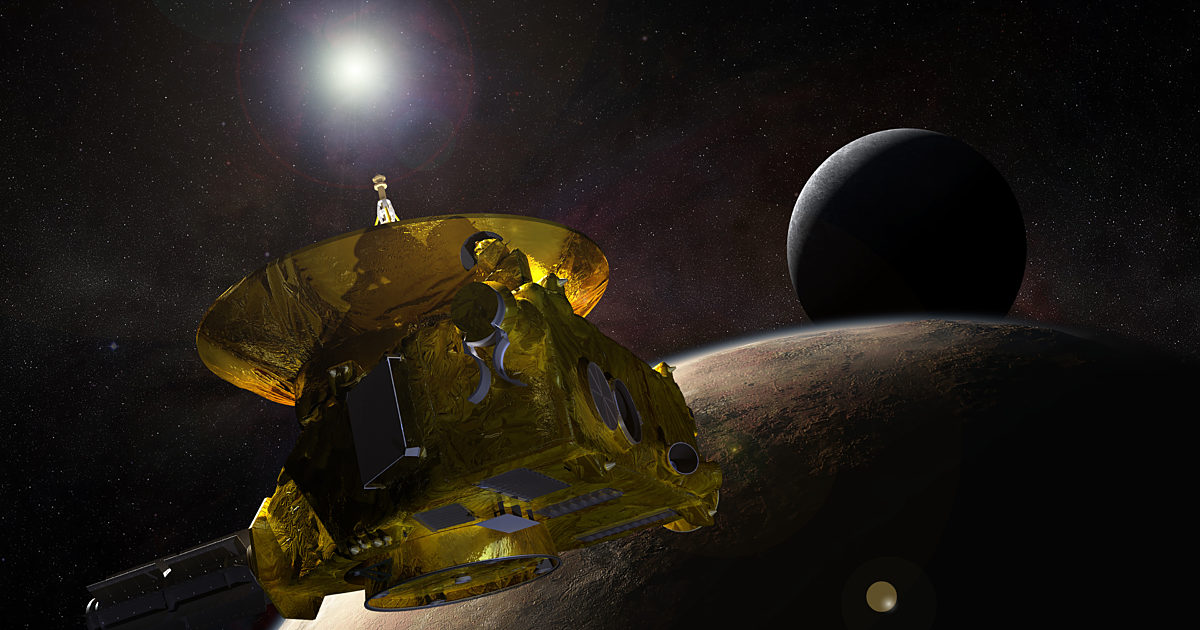
NASA will turn off two functioning instruments aboard New Horizons starting October 1, 2026. The SWAP (Solar Wind Around Pluto) and PEPSSI (Pluto Energetic Particle Spectrometer Science Investigation) instruments will power down to reduce costs, despite the spacecraft remaining healthy with enough power and fuel to operate until around 2050.
New Horizons currently studies the outer heliosphere, the Sun's magnetic bubble of charged plasma. The spacecraft will eventually cross the termination shock around 80-100 AU from the Sun, then traverse the heliosheath before reaching the heliopause at roughly 120 AU. Beyond lies interstellar space. Voyager 1 and 2, launched in 1977 and still operating, crossed these regions but lack the particle and energy measurement capabilities of SWAP and PEPSSI.
Kirby Runyon, a planetary geologist at the Planetary Science Institute, writes that the heliosphere's size may directly affect Earth's climate and the evolution of life. Geologic records show traces of isotopes iron-60 and plutonium-244 dating to episodes 2 and 7 million years ago when Earth's atmosphere was directly exposed to interstellar space. Computer models show the heliosphere can compress to 0.22 AU from the Sun when it encounters a cold, dense interstellar cloud, exposing Earth to neutral hydrogen and galactic cosmic rays that would increase cloud nucleation and cause climate fluctuations.
Only New Horizons' SWAP and PEPSSI can measure how the solar wind interacts with the very local interstellar medium. Runyon states the instruments could help determine how being within or outside the heliosphere affects radiolysis, the process of creating new chemical species through radiation. This process produces tholins, visible in Titan's atmosphere and on Charon's north pole. Understanding radiolysis matters for prebiotic chemistry and potentially habitable ocean worlds throughout the Solar System, including dwarf planets in the Kuiper Belt.
Runyon notes that Voyager 1 and 2 lack scientific instruments capable of measuring these plasma environments. He calls New Horizons "our only chance" for most humans alive today to measure the link between interstellar space, the heliosphere, habitable ocean worlds, and Earth.