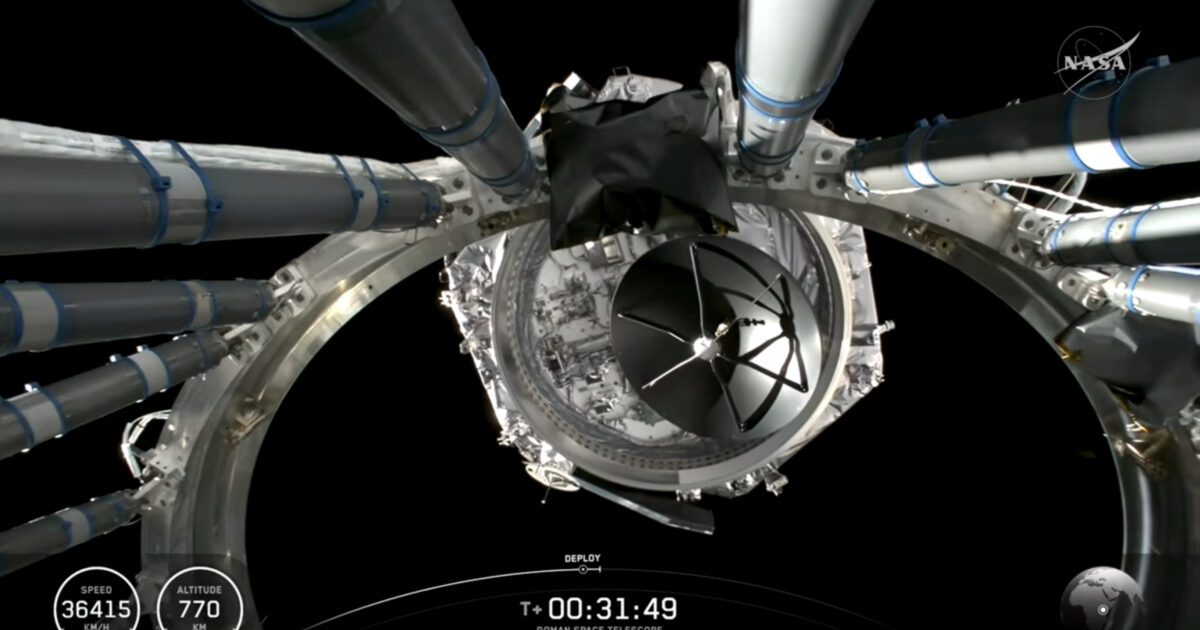
The Nancy Grace Roman Space Telescope launched this week aboard a SpaceX Falcon Heavy rocket and is now traveling to Sun-Earth Lagrange Point 2, about 1.5 million kilometers away. Roman's primary mission targets dark matter, dark energy, and exoplanets beyond our Solar System. The telescope is expected to discover approximately 1,000 previously unknown moons of Jupiter, 200 moons of Saturn, 100 moons of Uranus, and 5 moons of Neptune.
NASA's New Horizons spacecraft, which captured the first close-up images of Pluto, faces potential shutdown of two science instruments due to lack of funding. The probe currently orbits 66 times farther from the Sun than Earth and remains in good health.
NASA's Curiosity rover has gained one kilometer of elevation on Mars while climbing the 5-kilometer-tall Mount Sharp, where it has operated since 2012.
NASA's Pandora mission, a small space telescope designed to observe stars and their planets in visible and infrared light, has begun science operations to better understand exoplanet atmospheres.
The European Space Agency's Juice mission will conduct a close flyby of Kallichore, a small, dark, irregular moon with a retrograde orbit around Jupiter, in 2031.
NASA selected Blue Origin to provide its Mars Telecommunications Network, awarding the company a $700 million contract to deliver an orbiter by the end of 2028. The network will provide high-bandwidth communications and navigation services for current and future Mars missions.