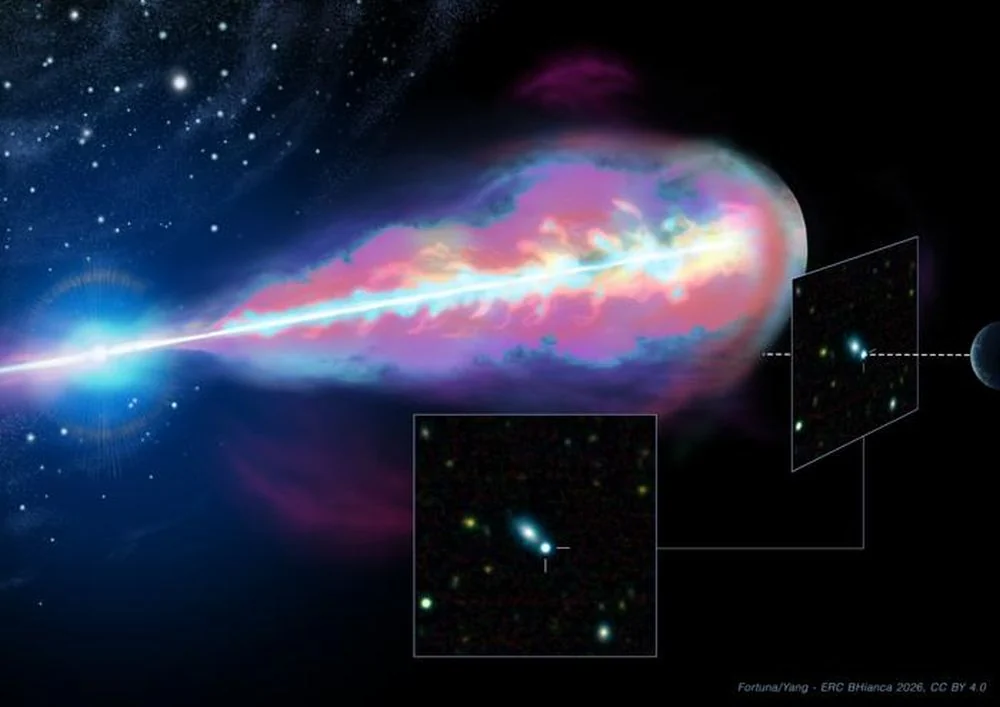
NASA's Fermi Gamma-ray Space Telescope detected an unusual gamma-ray burst on March 10, 2026, named GRB 260310A. The burst had a weak initial gamma-ray flash lasting nearly one minute, but its afterglow brightened dramatically in visible light over hours and remained unusually bright in X-rays for months.
An international research team led by Yu-Han Yang at the University of Rome Tor Vergata published findings in The Astrophysical Journal Letters explaining the oddity. The burst's strange signature came from viewing angle. Most detected GRBs point directly at Earth, appearing brightest head-on like a flashlight. GRB 260310A arrived from a side angle, revealing its structure as the jet slowed and became visible across wider angles.
Observations from NASA's Chandra X-ray Observatory, ESA's XMM-Newton, the China/ESA Einstein Probe, the Large Binocular Telescope, the Karl G. Jansky Very Large Array, and Calar Alto Observatory in Spain confirmed a supernova at redshift z ≃ 0.153 behind the burst. Despite modest prompt gamma-ray output, GRB 260310A produced one of the brightest afterglows ever recorded in X-ray, optical, and radio bands. Its X-ray and optical afterglows ranked in the top 1% of brightness, and radio brightness in the top 5%.
The researchers identified two separate shock components in the burst: a reverse shock dominating radio through optical wavelengths and a forward shock contributing to optical light and dominating X-rays. A peculiar X-ray rebrightening roughly 20 to 30 days after initial detection suggested late-stage energy injection or additional jet structure.
"We see hundreds of GRBs every year, but the oddballs are the most informative ones," said co-author Roberto Ricci, who led radio observations. "We could explain individual features of this burst, but fitting them all into the same picture proved much harder."