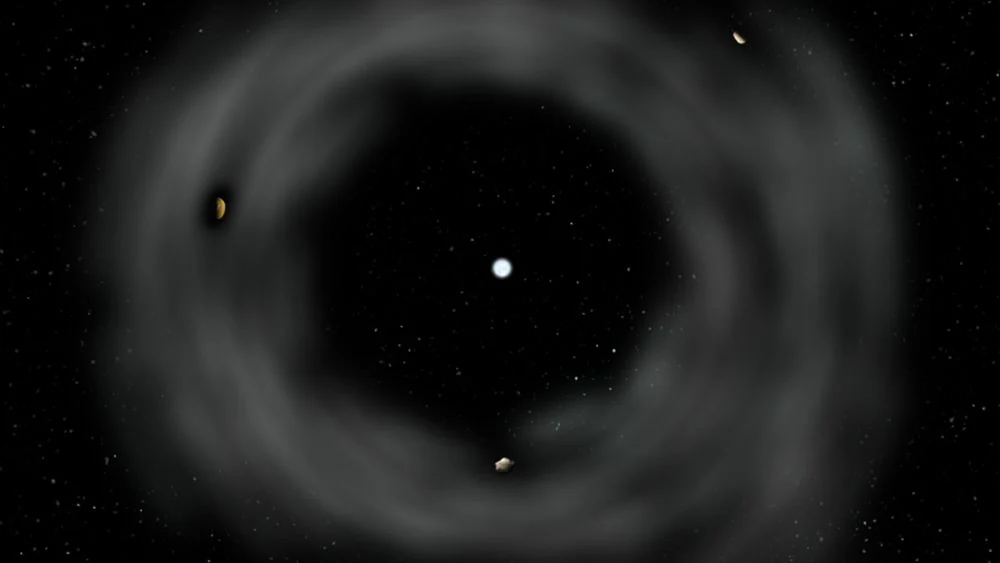
A new study shows that tidal forces around white dwarfs cannot break asteroids into dust as efficiently as previously thought. Researchers led by Jordan K. Steckloff at the Planetary Science Institute examined how white dwarfs shred rocky bodies and found a fundamental limit to the process.
The research, titled "Size Limits on Tidal Debris around White Dwarfs: The Kilometer-size Barrier" and published in The Astrophysical Journal Letters, accounts for Van der Waals forces. These weak atomic attractions hold rubble-pile asteroids together. All three asteroids sampled by spacecraft—Itokawa, Ryugu, and Bennu—are rubble piles.
When Steckloff's team included this cohesive strength in their models, they found that tidal fragmentation produces a maximum fragment size of about 0.1 to 1 kilometer in diameter. "Nothing is truly strengthless," Steckloff said. "Tiny attractions between grains called Van der Waals forces give comets and asteroids a minimum strength 10 to 100 times weaker than pulling apart freshly fallen snow."
The observation matches what happened to comet Shoemaker-Levy 9 in 1992. Jupiter's tidal forces tore the comet into fragments 100 to 1,000 meters across, not dust.
The findings create a problem for explaining the dusty disks observed around white dwarfs like WD 1145+017. If tidal forces alone cannot produce particles small enough for Poynting-Robertson drag to spiral them onto the white dwarf's surface, another mechanism must generate the dust. The authors propose collisions between fragments as a likely dust-generating factor.
"Understanding the progression from an intact minor planet to a sea of dust that is accreted onto a white dwarf is an outstanding challenge," the authors write. The work establishes a sharp constraint on the first step of that process.