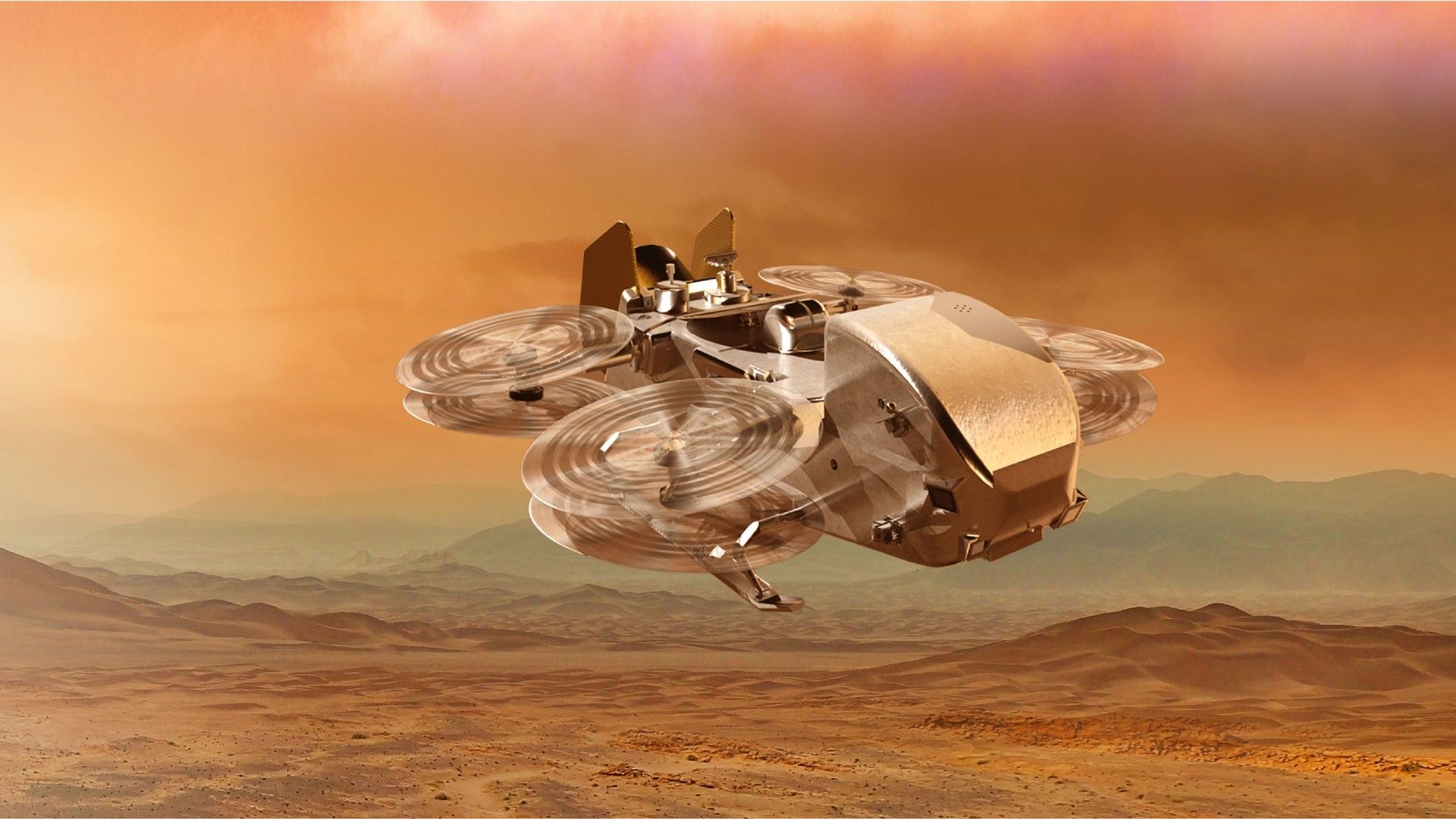
NASA opened a public portal in late October to allow people to submit their names for placement on a microchip aboard Dragonfly, an SUV-sized nuclear-powered rotorcraft headed to Saturn's moon Titan. The deadline for name submissions is Jan. 15, 2027. The names will be affixed to the chip during spacecraft assembly.
Dragonfly launches toward Titan in 2028 and arrives in 2034. The rotorcraft will fly between locations miles apart on Titan's surface, operating for approximately 3.3 Earth years. NASA says Dragonfly will make one flight every one to two Titan days, called a Tsol, which lasts about 16 Earth days.
The mission will explore dunes and a young impact crater named Selk. At each site, Dragonfly will collect surface material samples for analysis using onboard scientific instruments. Titan possesses an atmosphere, rivers, lakes, seasons, and organic-rich material on its surface.
Dragonfly's science objectives include studying prebiotic chemistry, determining whether Titan had habitable conditions in the past, and searching for chemical indicators of life based on water or hydrocarbons.
Dragonfly joins a small group of flying craft on other worlds. NASA's Ingenuity helicopter arrived on Mars with the Perseverance rover in 2021. Though designed for five flights, Ingenuity completed 72 flights before its blades sustained damage during a landing on Jan. 18, 2024. Cassini's Huygens lander touched down on Titan on Jan. 14, 2005, operating for several hours and measuring the moon's atmosphere. Cassini itself flew by Titan over 100 times before the mission ended in September 2017.