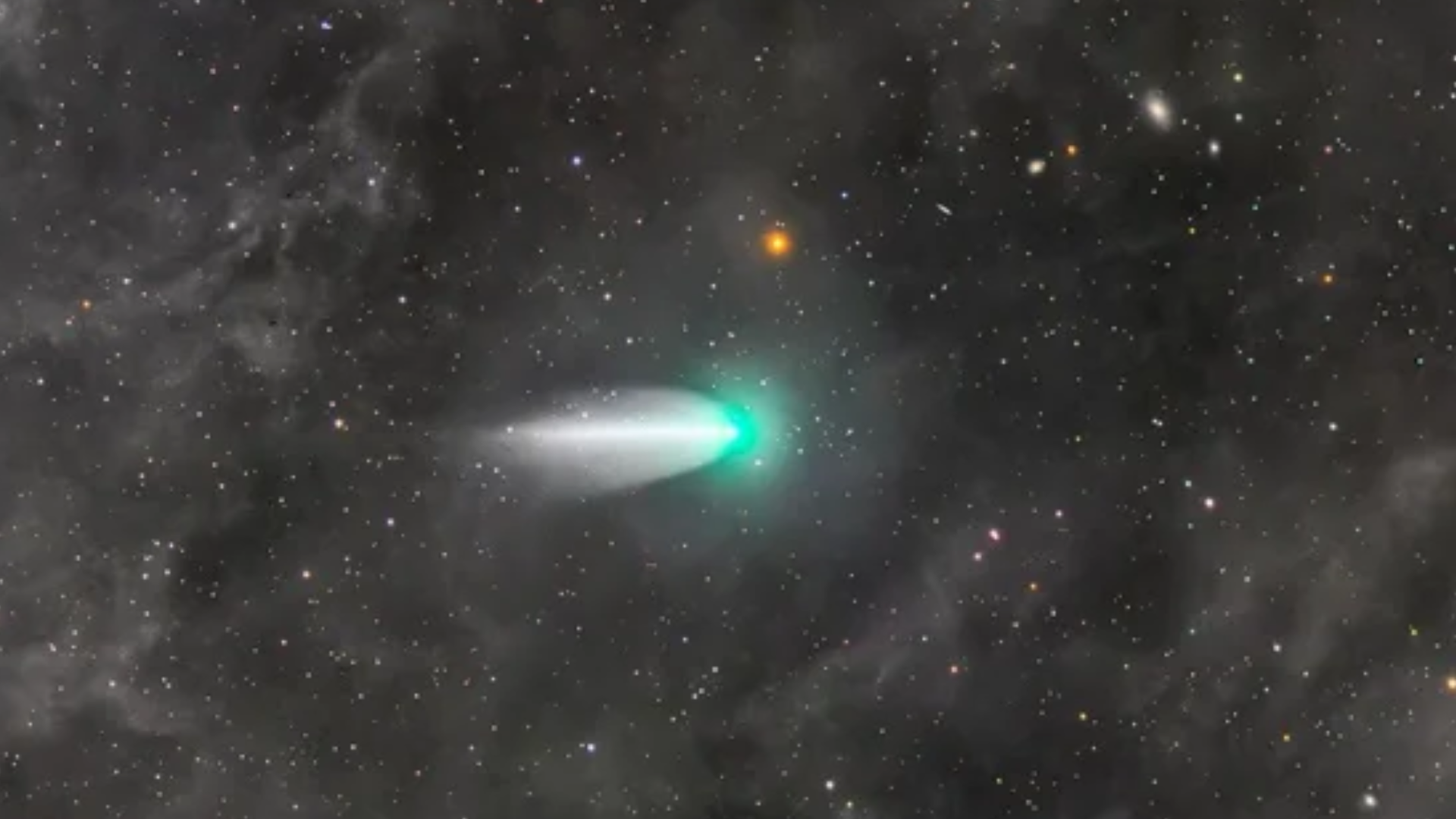
Comet 220P/McNaught burst into unexpected brightness this summer as solar heating caused subsurface ices to sublimate into gas, rupturing the comet's crust and ejecting tens to hundreds of billions of pounds of dust into space. The comet, discovered by Australian astronomer Robert McNaught in 2004, normally languishes too faintly to observe with amateur telescopes. On May 31, it brightened from magnitude +17.39 to magnitude +11.05 within less than 14 hours, entering range for small amateur scopes. By June 2, it had reached magnitude +8.23 and became briefly visible in 10x50 binoculars from dark sites. A second outburst began at the end of July, with the comet brightening from magnitude +14 on July 28 to magnitude 6.1 by August 6.
Josep M. Trigo-Rodríguez of the Institut de Ciències de l'Espai in Spain stated that observations indicated the comet detached localized parts of its crust, increasing brightness by 250 times in half a day. Dust particles millionths of a meter across expanded outward at roughly 1,280 feet per second, scattering sunlight and brightening the coma.
220P/McNaught orbits the sun every five-and-a-half years at distances ranging from 1.5 astronomical units at perihelion to 4.68 astronomical units at aphelion. Its short orbit classifies it as a Jupiter-family comet, originating from the Kuiper Belt and Scattered Disk. Trigo-Rodríguez noted that studying these outbursts reveals the fragile nature of Jupiter-family comets and provides information about objects from beyond Neptune's orbit, relevant to understanding impact hazard mitigation strategies. The findings appeared November 3 in the Monthly Notices of the Royal Astronomical Society.