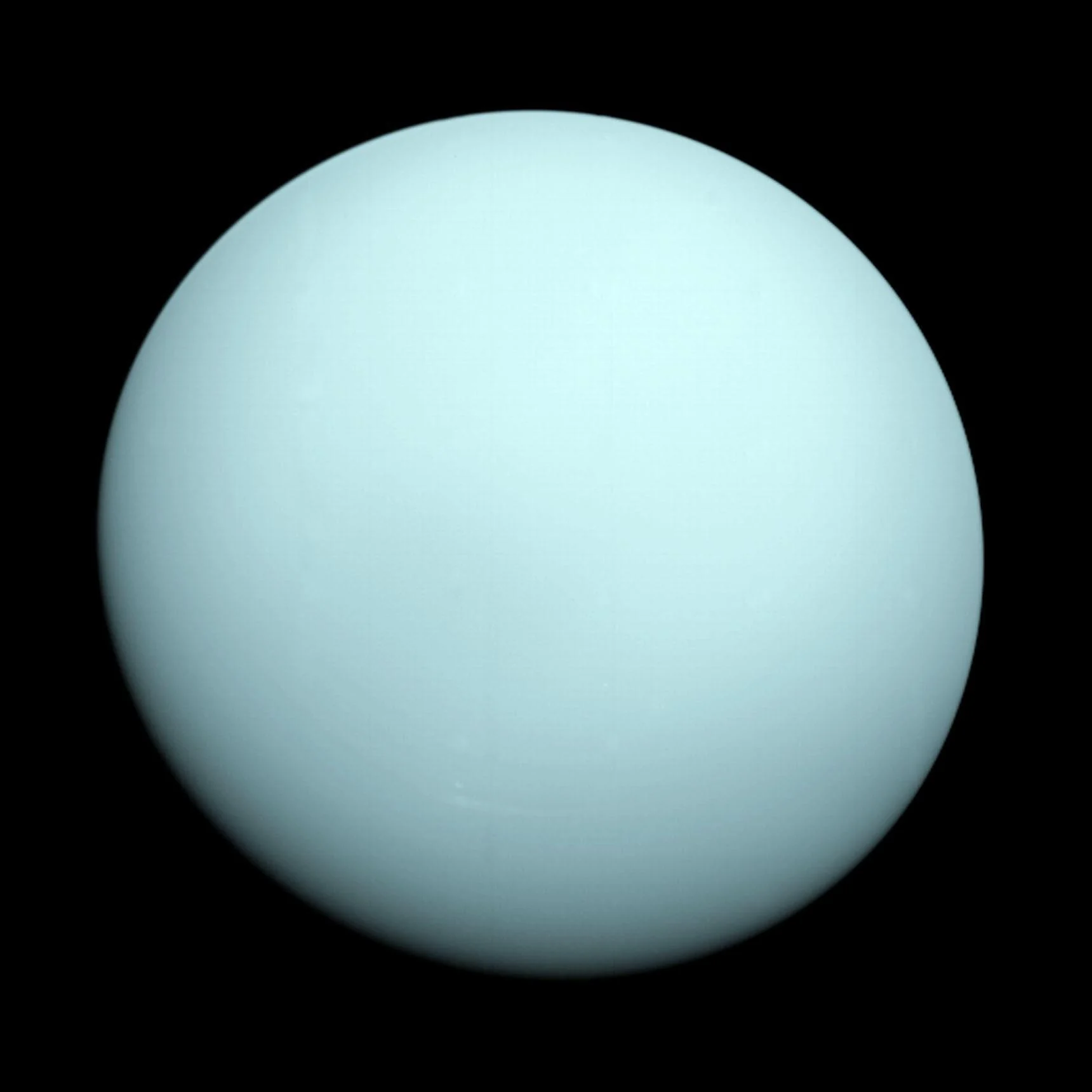
Uranus reaches opposition on November 25th, 2026, the same date as the Full November Beaver Moon. At opposition, the planet rises opposite the setting Sun as seen from Earth. Uranus will appear in the constellation Taurus between the Hyades and Pleiades star clusters.
Uranus orbits the Sun once every 84 years and has a synodic period of 370 days, meaning oppositions slide forward about five days each year. The planet currently sits 20 Astronomical Units from the Sun, having reached aphelion in 2009, and moves inward toward perihelion at 18.3 AU, which it will reach in 2050.
Observers can spot Uranus at magnitude +5.5 near opposition by sweeping the suspect field at low power and looking for a blue-green "star" that refuses to snap into focus. The planet sits at the edge of naked-eye visibility from a good dark sky site, topping +6th magnitude near opposition. Through a telescope, Uranus shows only a 4-inch disk and reveals minimal detail.
Uranus tips 98 degrees on its side, likely from an ancient collision early in the solar system's history. Currently, observers look nearly directly at the planet's rotational pole. Of its 29 known moons, five lie within reach of amateur telescopes, with Titania the brightest at magnitude +13.9.
Only one NASA mission has visited Uranus close up: Voyager 2 flew past the planet and its moons in 1986. Cassini-style orbiters have been proposed for the 2040s timeframe, though such a mission would require years to reach the distant ice giant and slow down to enter orbit.