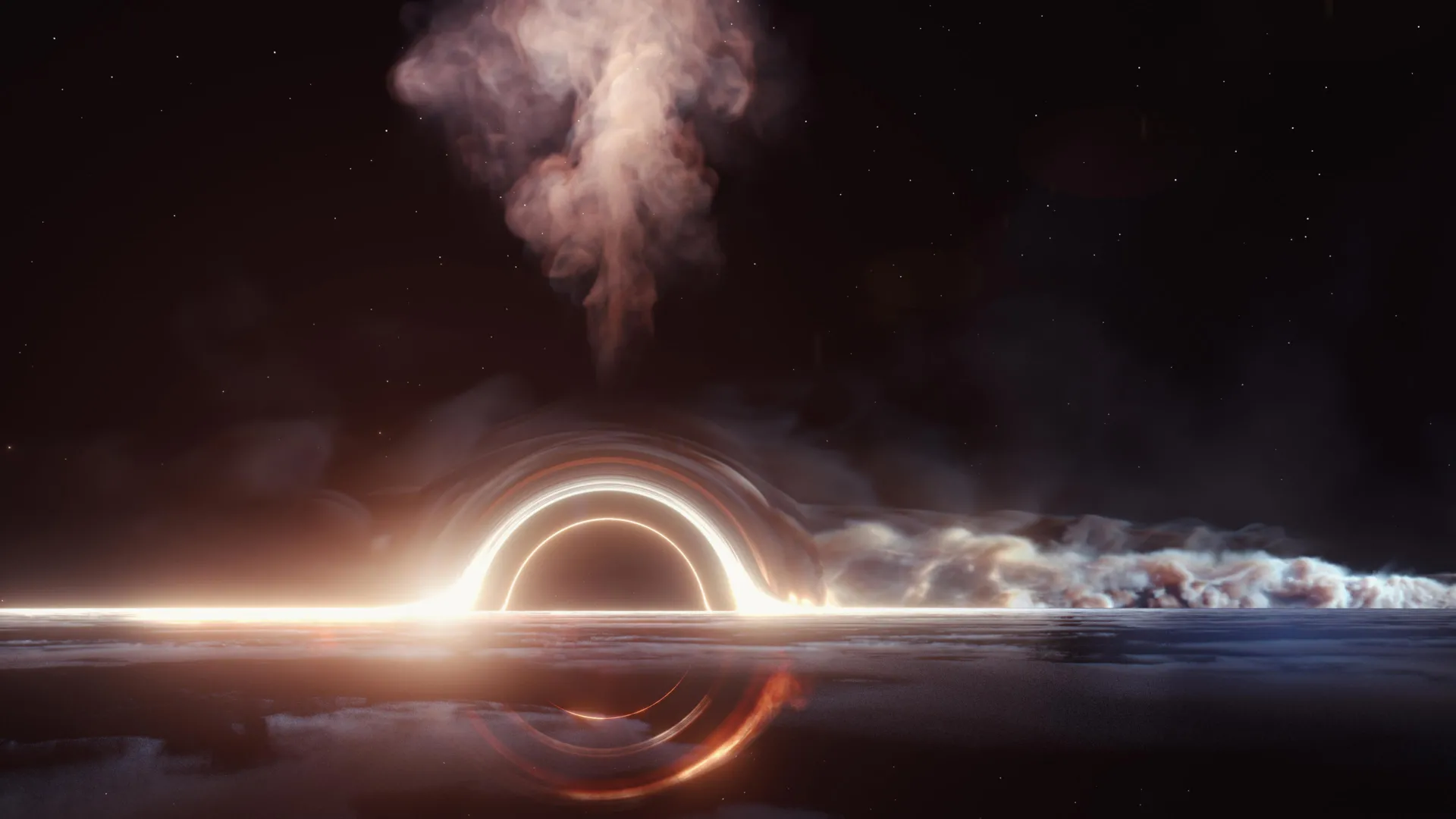
Astronomers have discovered that black holes follow a universal rule governing when they launch powerful jets into space, regardless of their mass. The finding, published in Nature Astronomy, shows that black holes activate delayed jets at the same critical feeding rate, about 2% of their Eddington limit, whether they weigh 10 times the Sun's mass or millions of times more.
Dr. Adelle Goodwin at Curtin University's International Centre of Radio Astronomy Research led the research with Dr. Andrew Mummery of the Institute for Advanced Study in Princeton. The team studied tidal disruption events, rare occurrences where a star passes too close to a supermassive black hole and gets torn apart. These events compress years of black hole behavior into a short timeframe, allowing astronomers to observe feeding cycles that normally play out over thousands of years.
The researchers examined 20 tidal disruption events using data collected in visible light, ultraviolet, X-rays, and radio wavelengths, then focused on 10 events with reliable measurements of both feeding rates and radio outflow timing. The observations revealed two distinct jet-production stages. The first occurs early when the black hole consumes matter at exceptionally high rates. The second happens later, hundreds or thousands of days after the star's destruction, when the black hole's feeding rate drops to the 2% threshold.
"These black holes are separated by enormous differences in mass, but they appear to switch on their jets at the same point in the feeding process," Goodwin said. "That tells us something fundamental about black holes: the physics does not seem to care how big they are."
This threshold matches the rate already known to trigger jet formation in smaller black holes within the Milky Way. The discovery could help astronomers use radio telescopes more efficiently by predicting when delayed jets are likely to appear. Goodwin noted that "knowing when to look is just as important as knowing where to look," and better predictions could optimize observing time on facilities like the Square Kilometre Array Observatory, which Australia is hosting at a cost exceeding $387 million in Australian investment.